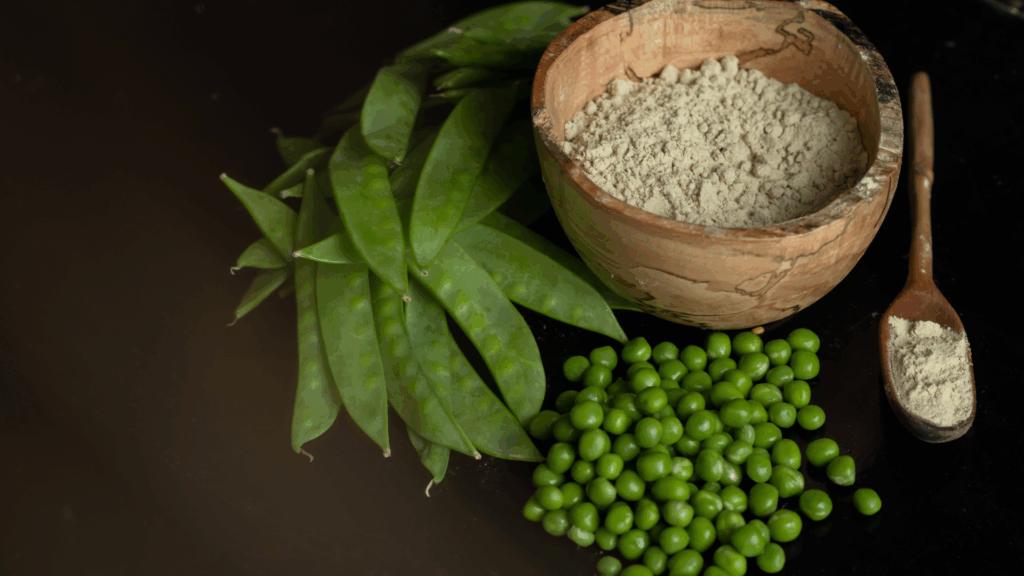
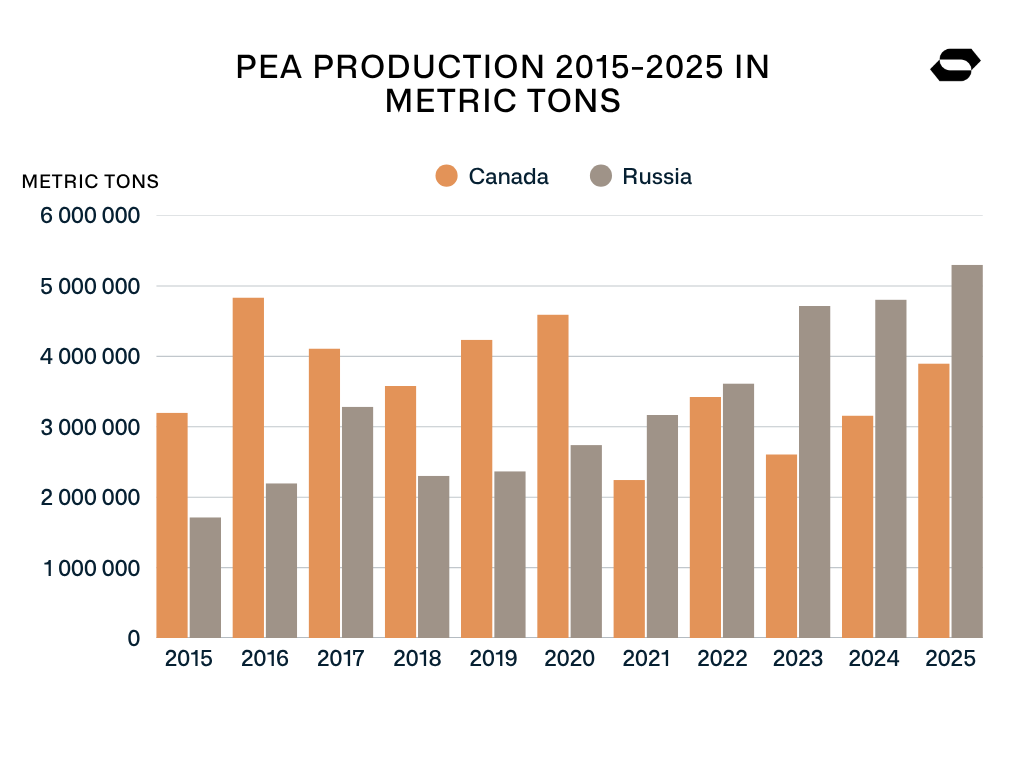
The pea market in 2026 is shaped by the 2025 crop and a clear surplus across key origins. Russia confirmed its position as the largest producer, with output exceeding 5 million tonnes, while Canada remains a key producing and export country, returning to stronger production levels after a weaker previous season. This combination keeps overall supply high and continues to pressure prices, which remain at relatively low levels.
At the same time, trade flows have shifted. Throughout most of 2025, Canadian exporters had limited access to China due to tariffs, which forced them to look for other markets. Although tariffs were lifted on March 1, the main sales window was already missed. This keeps Canadian supply active on the global market and puts pressure on prices, while in Europe the main competition still comes from regional origins.
Russia: Record crop but limited export growth
Russia remains the largest pea producer globally, with the 2025 crop estimated at over 5 million tonnes. However, the key issue is not production, but the ability to export this volume. The market is currently dealing with a global pea surplus, as export growth has not kept pace with increasing output.
China was the largest single destination for Russian peas, accounting for around 30% of exports in the previous season. However, growth into this market has been limited. At the same time, India – the second key market – reduced its demand significantly in 2025, mainly due to higher domestic pulses production. Total Indian pea imports dropped to just over 320k tonnes, compared to nearly 900k tonnes in 2024.
This shift is critical. Russia was counting on India to absorb more volume, but instead faced a contraction in demand, mainly due to bigger domestic production in India. Bangladesh, which was a major buyer in the previous season, remains relevant, but is not large enough to balance the market. In practice, this leaves Russia with limited options. New markets are still relatively small, while margins on peas remain low. As a result, exporters are forced to keep volume moving, often at more competitive price levels.
Looking ahead, low margins and current market conditions may lead to a reduction in planted area. However, this adjustment will take time, meaning supply pressure is likely to remain in the short term.
Canada: Back on volume, still missing China
Canada returned to stronger production levels in 2025, with the crop estimated at around 3.9 million tonnes. The increase was mainly driven by improved yields, confirming Canada’s position as the key export-oriented origin in the global pea market.
However, production is only part of the story. The main challenge for Canada in 2025 was limited access to China during the peak export window. Tariffs effectively blocked shipments for most of the season, forcing exporters to redirect volume into alternative markets, including Europe, Southeast Asia, and the Middle East. Although the tariffs were lifted on March 1, 2026 the timing meant that a significant part of the sales cycle was already lost.
As a result, Canadian peas remain widely available on the global market. Exporters continue to actively look for outlets, which keeps offers competitive, especially for standard specifications. At the same time, demand remains selective, with buyers focusing more on quality, consistency, and execution rather than just price.
Looking ahead, Canada’s role remains unchanged. It continues to set the export benchmark, but without strong Chinese demand, it needs to rely more on diversified markets, which may limit price recovery in the short term.
Europe: Trying to rely less on imports
The European pea market showed stronger production in 2025, with output increasing compared to the previous season. Improved yields supported the crop, despite relatively stable planting area, confirming a gradual push to strengthen domestic protein production.
At the same time, trade flows have shifted significantly. Import tariffs on Russian agricultural products effectively reduced inflows from Russia, forcing the EU to rebalance its sourcing strategy. The priority has been to increase domestic supply first, and then complement it with imports from closer and more accessible origins. Ukraine, in particular, increased its pea production in 2025 compared to 2024, while Kazakhstan also gained importance as an alternative supplier.
This combination has reduced reliance on traditional import channels and changed the structure of supply into the region. However, this shift remains partial. Europe is still linked to global markets, especially when demand accelerates or when consistent quality and volumes are required.
Europe is not just buying less from Russia – it is rebuilding its supply model around domestic and regional sources.
Organic Peas in EU: Local supply first
The organic pea market in Europe is primarily built on domestic production rather than imports. Buyers strongly prefer EU-origin, as it is easier to control, aligns with certification requirements, and supports marketing and positioning strategies. France, Germany, and Italy remain the key producers, with additional growth seen in the Baltics and Balkan countries.
Production has been gradually increasing, but availability of consistent, high-quality material remains limited. This is especially visible in the food segment, where issues such as pest damage (pea weevil) and variable quality continue to restrict usable volumes. As a result, not all organic pea batches are market ready.
Imports still play a role, particularly from Ukraine, but they complement rather than define the market. In practice, organic peas in Europe remain strongly program-driven, with buyers securing volumes in advance rather than relying on spot availability.
Pea market summary
The pea market in 2026 is defined by high supply and weak demand. Russia and Canada both have large volumes, but key buyers like China and India reduced imports. Other markets are not taking much more either. This gives buyers a strong position, with access to low prices and wide choice of origins.
At the same time, Europe is changing how it sources peas. More product comes from local production, and less from Russia, with more focus on nearby origins like Ukraine. In organic, supply is mostly local, but good food-quality peas are still limited.
Source:
- https://www.grainscanada.gc.ca/en/grain-research/grain-harvest-export-quality/peas/2025/harvest-quality-report-peas-2025.html
- https://www.reuters.com/world/china/russia-has-surplus-peas-after-failing-boost-exports-china-analysts-say-2025-12-11/?utm
- https://www.ufop.de/english/news/chart-week/?utm
- https://www.kmu.gov.ua/en/news/zhnyva-2025-shchotyzhneva-statystyka141125
- https://www.cbi.eu/market-information/grains-pulses-oilseeds/what-demand
- https://agriculture.ec.europa.eu/system/files/2025-05/analytical-brief-7-eu-organic-imports-brief_en.pdf
- https://www.ufop.de/files/4817/7279/0898/26_10_E_W_dry_peas.pdf
- https://www.alta.ru/external_news/126000/
- https://saskpulse.com/resources/global-market-outlook-for-peas-lentils/
- https://agpulseanalytica.com/market-insights/european-commission-raised-pea-production-estimates-in-june-published-report-for-my-202526